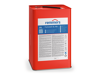
Article No. 547305
Clear, silane/siloxane-based hydrophobising impregnation, specially designed for solvent-sensitive building materials and connecting areas, as well as for limestone
Downloads & documents
Product specifications
The stated values represent typical product characteristics and are not to be construed as binding product specifications.
Field of application

- Protection of facades against driving rain
- Reduces susceptibility to dirt and green discolouration
- Porous, mineral building materials, in particular limestone
- Mineral surfaces that border or contain elements sensitive to solvents, such as polystyrene (core insulation or full thermal insulation systems) or bitumen
- Subsequent treatment/renewal of hydrophobic surfaces
Properties

- Improves resistance to frost and de-icing salts
- Highly water-repellent
- Enables water vapour diffusion
- Good penetration capacity
- UV-resistant
- Alkali-resistant
- Excellent long-term effect
- Compatible with building materials that are sensitive to solvents
- Reduces energy loss
- PFAS-free formulation
-
Preparation
-
Substrate requirements
The substrate must be clean, dust-free and dry.
-
Preparations
Any construction defects such as cracks, cracked joints, defective connections, rising damp and hygroscopic moisture must be remedied in advance.
Perform any necessary cleaning gently, e.g. by spraying with cold or warm water or by steam-cleaning; use soft whirl jet technology or Remmers cleaning products (e.g. Traffic Film Remover (0671), Clean FP (0666), Clean AC (0672), Combi WR (0675)) on tough stains.
-
-
Application
-
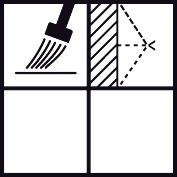
Apply the primer abundantly by flow coating without pressure (avoid misting), so that a 30 - 50 cm long liquid film flows down the surface.
Apply horizontally on one section at a time, moving from top to bottom, and immediately go over with a wide brush.
Repeat the application several (at least two) times (wet on damp) until no further material is absorbed by the substrate.On surfaces where spray application is not possible, apply using a well-saturated brush.
-
-
Application instructions
-
Take appropriate measures to protect adjacent building elements and materials that should not come into contact with the product.
Protect freshly treated surfaces from driving rain, wind, sunlight and condensation.
Use an absorbent sponge to remove excess impregnation agent within 1 hour.
-
-
Working tools / cleaning
-
Solvent-resistant low-pressure, conveying and spraying equipment, liquid pump, paintbrush and flat brush
Tools must be clean and dry.
Clean tools with methylated spirits after use and before long pauses in work.
-
-
Storage / shelf life
-
If stored unopened in its original container in a cool, dry place and protected against frost, the product will keep for at least 24 months.
Use the contents of open containers as quickly as possible.
-


-
Usage
-
Sand-lime brick, smooth: min. 0.5 l/m²
Sand-lime brick, cleft: min. 0.7 l/m²
Fibre cement: min. 0.3 l/m²
Concrete: min. 0.5 l/m²
Brickwork, fine-pored: min. 0.8 l/m²
Render: min. 0.5 l/m²
Thermal insulation render: min. 0.6 l/m²
Aerated concrete: min. 1.0 l/m²
Lightweight concrete: min. 1.0 l/m
Natural stone, fine-pored: min. 0.2-0.5 l/m²
Natural stone, coarse-pored: min. 0.4-1.5 l/m² -
Apply to a large enough trial surface (1-2 m²) to determine the precise amount of impregnation agent required.
-

-
General information
-
Current regulations and legal requirements must be taken into account and deviations from these must be agreed separately.
The relevant test certificates must be observed when planning and carrying out work.
The level of absorption is crucial for the impregnation agent to work at its best. This depends on the respective pore volume and moisture content of the building material.
Carry out a quantitative analysis of aggressive salts if there are any salts present that could damage building materials.
High concentrations of harmful salts can cause major structural damage that impregnation cannot prevent.
Water must not be allowed to penetrate behind the hydrophobized zone.
Testing effectiveness:
The water absorption of mineral building materials can be determined using the Funcosil Test Tube developed by Professor Karsten (Funcosil Facade Testing Kit, article no. 4954).
Testing can only be carried out at the earliest 6 weeks after application.For all new products (RTS test on walls with brick pointing), full effectiveness was achieved after 4 weeks.
A test of effectiveness needs to be carried out on carbonaceous natural stone.
The setting process of cementitious building materials must be complete before Funcosil SL Alc is applied.
Always set up a trial area/trial areas first.
-
-
Disposal instructions
-
Larger quantities of leftover product should be disposed of in the original containers in accordance with the applicable regulations. Completely empty, clean containers should be recycled. Do not dispose of together with household waste. Do not allow to enter the sewage system. Do not pour liquid coating or residues down the drain, even when cleaning tools used for applying the coating.
-
-
Safety / regulations
-
For further information on the safety aspects of transporting, storing and handling the product and on disposal and environmental matters, please see the current Safety Data Sheet.
-